
Beyond the Environmental Balance Sheet: Why We Need a New Science of Resilience in Wales
Why do so many Nature-based Solutions fall short against compound flooding? We need to stop treating nature like green concrete. Discover why understanding complex ecological feedbacks is the real key to Wales' climate resilience.


The 2025 SoNNAR report from Natural Resources Wales was a difficult reality check for anyone who cares about our landscape. It was a damning indictment, showing that Wales has allowed its natural systems to degrade almost more than anywhere else in Europe. We stand at a crossroads: prioritise our environment now, or wait for the mounting bills.
The scale of the threat is immense. Today, Natural Resources Wales estimates that roughly 1 in 7 properties across the country—some 275,000 homes and businesses—are at risk of flooding. This isn't just a Welsh problem. Globally, a massive percentage of our towns and cities are built on rivers and estuaries, placing huge populations directly in the firing line. And that line is shifting. As our climate warms, we are seeing a well-documented increase in the frequency and intensity of storms that bring both torrential rain and gale-force winds simultaneously. This creates a worst-case scenario: "compound flooding." Compound flooding is a devastating trifecta. It occurs when exceptionally high river flows, driven by heavy inland rainfall, collide in an estuary with incoming coastal storm surges and high tides.
Yet, our approach to tackling this is fundamentally flawed by how we frame the natural world. Too often, nature is viewed as a regulatory burden or boiled down to an environmental profit and loss account based on timber yields or carbon storage. The things that are harder to price - like the intricate, dynamic mechanics of flood mitigation- get undervalued, oversimplified, and ultimately ignored. And this oversimplification is prevalent in how we approach Nature-based Solutions (NbS).
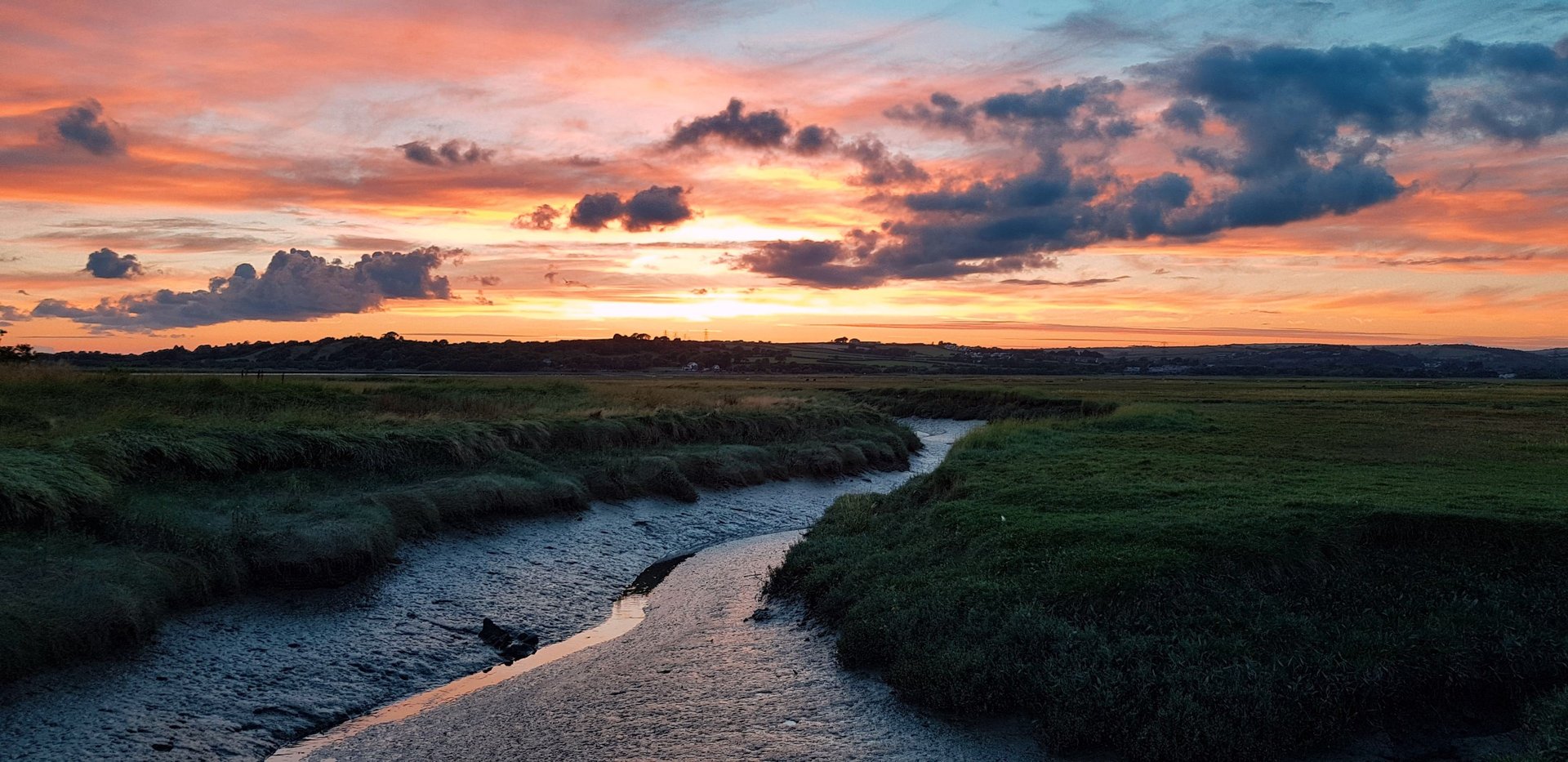
Right now, a lot of funding is directed toward NbS designs that essentially treat nature as a greener version of concrete. The prevailing logic often assumes that if we just front a sea wall with a patch of saltmarsh, we have provided local protection. But living right by the Loughor Estuary, I see first hand that the reality of how water interacts with ecology is rarely that linear.
Most of our historical studies have focused on how coastal marshes attenuate short, sharp waves rolling in from the sea (building on foundational work by Möller and others). But in Wales, fronting marshes are the exception. Our primary flooding drivers are those compound events pushing into wave-sheltered estuaries. A storm surge or massive river flood is fundamentally different from a wave; it is a massive, long-duration volume of water. A thin strip of fronting marsh simply cannot stop it.
While creating more wetland area is broadly beneficial, it introduces incredibly complex physical pressures that our current engineering models often ignore. For years, hydrodynamic models (like Nepf’s classic studies) have treated vegetation as rigid cylinders. But as work by Thomas Van Veelen and others has shown, real marsh vegetation is flexible and highly sensitive to water velocity. During a massive river flood or storm surge, high flow volumes actively flatten flexible marsh plants, pushing them down against the bed. Depending on the species and the flow, this flattening can drastically reduce the drag the plants provide, or alter how that drag oscillates along the bed.
To actually slow these massive volumes of water, you cannot rely on a localised patch of marsh. As we demonstrated in our 2021 Environmental Research Letters paper, you need cumulative drag. You need to understand the interaction between specific types of vegetation, the wider extent of the wetland, and the sinuosity—the wigglyness—of the channel itself. Knowing where highly structural vegetation will be most effective and most likely to survive changing morphology is the key to making NbS successful and resilient under climate change (Smolders et al., 2015).
And all of this assumes the ecology remains healthy. What happens when these systems face cascading ecological failures? Biodiversity loss is accelerating, and with it comes the spread of Invasive Non-Native Species (INNS). If native riparian plants degrade and are replaced by invasive species, how does that alter the structural drag and sediment trapping we rely on to stop a flood? We strongly suspect that these altered communities are less suitable for flood mitigation, but our understanding of these interconnected ecological-environmental feedbacks is still severely lacking.
This is the exact sort of knowledge gap Spectral Ecology was founded to close. We need a new class of tools that move beyond rigid analogues and isolated metrics. We need next-generation models that utilise deep ecological, hydrodynamic, and sedimentological coupling. This is the only way to understand how non-linear dependencies affect both ecological health and flood mitigation, allowing us to anticipate the effects of multiple, simultaneous climate stressors on our natural infrastructure. But building these tools and applying them effectively cannot happen in a silo. Developing natural infrastructure that actually works requires deep cooperation across disciplines. We are actively looking to build a network of practitioners, policy makers, regulators, and field scientists to bring this forward. If this is something that would interest you, drop us an email. We need a shared culture that asks the difficult questions about nature's connectedness that have previously been ignored due to poor immediate ROI or a simple lack of imagination.
My daughter's future is tied to the decisions we make right now in ways that make me genuinely uncomfortable to think about. If we don't start engineering natural infrastructure that respects the true complexity of our environment, we are going to face a situation we literally cannot manage. I hope the new government in Wales recognises this and pushes for real reform, but regardless of politics, those of us in the sector must lead the way. It might start as a shift in how we model a single estuary, but it will mean absolutely everything for the future.





Spectral Ecology Limited - Registered in England and Wales: 16386647 VAT Number: 496380548 Email: tom.fairchild@spectralecology.com © Spectral Ecology limited (2026)